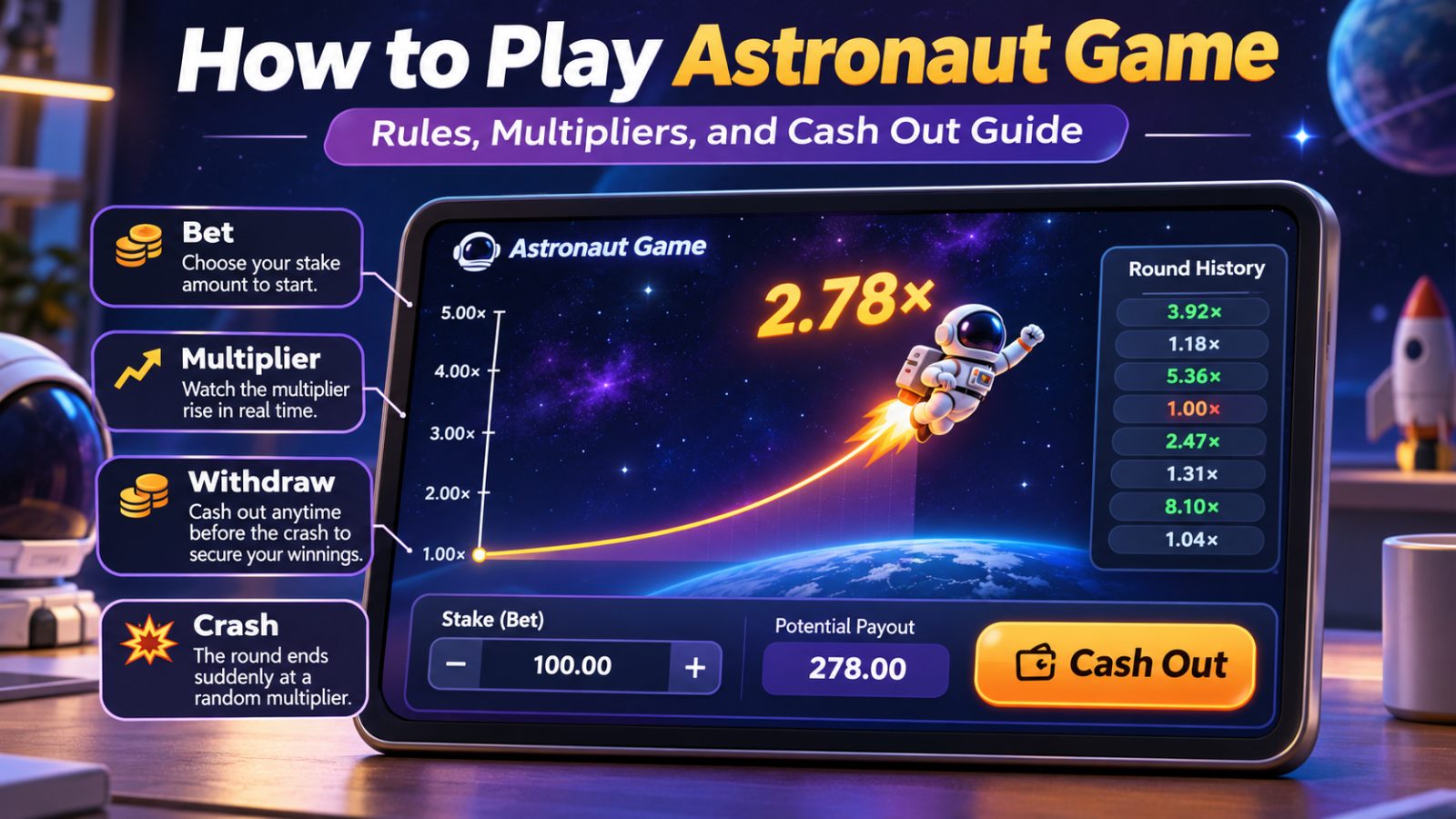
Astronaut is a space-themed crash game developed by 100HP Gaming. Unlike traditional slots, it has no spinning reels or paylines. Instead, players watch a rising multiplier and try to cash out before the round ends. The longer the flight continues, the higher the potential payout. However, the game can crash before the player collects anything. If you want to learn how to play astronaut game, start with the betting controls and cash-out rules. The astronaut slot uses a simple system: select a stake, watch the multiplier, and withdraw before the crash. This guide explains each step, including manual and automatic cash-out, payout calculations, dual bets, and common mistakes. All examples use virtual points to demonstrate the rules without financial risk.
What Is the Astronaut Game and How Does It Work?
Astronaut is a crash-style casino game created by 100HP Gaming. Each round features an astronaut travelling through space while a multiplier increases from 1.00x. Players select their stakes before the round starts. Once the astronaut launches, the multiplier begins rising. The objective is to withdraw the active stake before the flight ends. If the player withdraws successfully, the payout depends on the multiplier at that moment. If the crash happens first, the unsettled stake is lost. Unlike games based on card combinations or dice results, Astronaut centres on the timing of a single decision.
Astronaut Game Overview
The basic gameplay follows five stages:
1. Select a stake before the round begins.
2. Wait for the betting countdown to finish.
3. Watch the multiplier increase from 1.00x.
4. Request a withdrawal before the crash.
5. Receive the payout or lose the active stake.
The crash point is unpredictable. A round may end at a low multiplier or continue much longer. Astronaut also includes automatic controls and a dual-bet interface in documented versions. These features change how players manage their bets but do not make the outcome predictable.
Astronaut vs. Traditional Slot Games
Astronaut is sometimes listed under casino slots, but its mechanics are different. Traditional slots use symbols, reels, and winning combinations. Astronaut uses a continuously rising multiplier. Other simple casino games, such as 7 up 7 down, also differ from traditional slots. In that dice game, the result depends on whether the total of two dice is below, equal to, or above seven. Astronaut instead depends on whether a player withdraws before the crash.
| Feature | Astronaut | Traditional Slots |
| Game type | Crash | Reel-based |
| Main mechanic | Rising multiplier | Symbol combinations |
| Player action | Withdraw before crash | Start a spin |
| Round ending | Crash point | Reels stop |
| Paylines | None | Depends on game |
| Main uncertainty | Crash timing | Reel outcome |
The main difference is player interaction. In Astronaut, the player must decide when to request a withdrawal. In most traditional slots, the result is determined after the spin begins without a comparable cash-out decision.
How to Play Astronaut Game Step by Step
Astronaut follows a short, repeating gameplay cycle. Once the controls are familiar, each round becomes easy to follow.
Step 1: Open Astronaut and Check the Game Rules
Open the Astronaut game by 100HP Gaming and check the available play modes. Before starting, locate the information or rules menu. This section should explain the controls, stake limits, payout restrictions, and automatic features available in that version. Pay attention to the game title and provider. Other casino games use similar space themes but may have completely different mechanics. If a demo mode is available, it provides a way to examine the interface without using real money.
Step 2: Choose Your Bet Amount
The game includes a field for selecting the stake. Enter the amount before the betting countdown ends. Some versions also offer plus and minus buttons for adjusting the value. For example, suppose you enter 10 virtual points. That amount becomes your stake for the next round. If the round ends before you withdraw, those 10 points are lost. If you withdraw successfully, the multiplier determines the total payout. The minimum and maximum stakes depend on the game configuration. Always check the limits displayed in the current version.
Step 3: Wait for the Round to Start
Astronaut has a countdown between rounds. During this period, players can prepare their stakes and automatic settings. Once the countdown finishes, the betting window closes. The astronaut then launches, and the multiplier begins increasing. If you miss the betting window, you generally must wait until the next round to place a new bet. In documented versions, an accepted bet can be cancelled during the countdown. Once the flight starts, the player must withdraw successfully or wait for the result.
Step 4: Watch the Multiplier Increase
The multiplier starts at 1.00x and increases as the astronaut travels through space.
For example, the screen may display:
1.10x → 1.35x → 1.70x → 2.00x
A higher multiplier means a larger potential payout from the same stake. With a 10-point stake, withdrawing at 1.50x returns 15 points. At 2.00x, the total payout becomes 20 points. However, the displayed multiplier is not a guarantee that the round will continue. The crash can occur before the player reaches a selected target.
Step 5: Cash Out Before the Crash
Cash-out is the central action in Astronaut. During an active round, the player can press the withdrawal button to request payment at the current multiplier. The button may be labelled “Withdraw” rather than “Cash Out.” Suppose the multiplier reaches 1.80x and you successfully withdraw a 10-point stake. The total payout is 18 points, including the original stake. The net gain is 8 points. If you wait and the game crashes before your request is processed, the active stake is lost. There is no partial payout simply because the multiplier reached a high value shortly before the crash.
Step 6: Check the Round Result
After the crash, the game displays the completed round and its final multiplier. A successful withdrawal is settled according to the multiplier recorded when the request was accepted. An unsuccessful withdrawal results in the loss of the active stake. The game may also show a history of previous crash multipliers. This history is useful for reviewing completed rounds, but it cannot reliably predict the next result.
Astronaut gameplay flow:
Select Stake → Round Starts → Multiplier Rises → Withdraw or Crash → Result
Understanding Multipliers and Payouts in Astronaut

Multipliers determine how much a successful withdrawal returns. They are displayed as numbers followed by “x,” such as 1.50x, 2.00x, or 5.00x.
What Does the Multiplier Mean?
A multiplier shows the total payout relative to the original stake. At 1.50x, a successful withdrawal returns one and a half times the stake. At 2.00x, it returns twice the stake. The total payout includes the original stake. It should not be confused with profit. For example, a 10-point stake withdrawn at 2.00x returns 20 points. The net gain is 10 points, not 20. Higher multipliers offer larger potential payouts, but the round must continue long enough for the withdrawal to succeed.
How Are Astronaut Payouts Calculated?
The calculation is straightforward:
Total payout = Stake × Cash-out multiplier
The net gain is the total payout minus the original stake.
| Stake | Multiplier | Total Payout | Net Result |
| 10 points | 1.50x | 15 points | +5 points |
| 10 points | 2.00x | 20 points | +10 points |
| 10 points | 3.00x | 30 points | +20 points |
| 10 points | Crash before withdrawal | 0 | -10 points |
These examples assume no additional payout restrictions. Actual games may apply maximum payout limits.
What Happens When the Game Crashes?
The crash immediately ends the round. Any active stake that has not been successfully withdrawn is lost. Bets withdrawn before the crash remain settled. For example, if a round ends at 1.75x, a withdrawal completed at 1.50x succeeds. A player waiting for 2.00x loses the stake. The difference between these outcomes is the timing of the accepted withdrawal. A crash at 1.99x does not produce a payout for a 2.00x target.
Manual Cash Out vs. Auto Cash Out

Astronaut supports two main ways to withdraw an active bet: manual withdrawal and automatic withdrawal. Both use the same underlying crash result.
How Manual Cash Out Works
Manual withdrawal requires the player to press the Withdraw button during the round. The payout depends on the multiplier at which the request is accepted. For example, a player might see 2.25x on the screen and attempt to withdraw. If the request is completed before the crash, the corresponding payout is recorded. However, the multiplier can change while the player reacts. Connection delays and the timing of the request may also affect the result. Manual withdrawal provides direct control over the action, but it does not allow players to predict when the round will crash.
How Auto Cash Out Works
Auto Cash Out allows the player to enter a target multiplier before the round begins. For example, a target of 2.00x instructs the game to attempt an automatic withdrawal when the multiplier reaches that value. If the round reaches 2.00x and the automatic withdrawal succeeds, the bet is settled. If the round crashes at 1.80x, the target is never reached and the stake is lost. Automatic withdrawal can reduce the need for a manual click. It does not guarantee that the selected multiplier will be reached.
Which Method Is Easier for Beginners?
Auto Cash Out requires fewer actions during the round. Manual withdrawal requires the player to monitor the multiplier and respond in time. Neither method changes the underlying crash probability.
| Feature | Manual Cash Out | Auto Cash Out |
| Withdrawal | Player clicks | System processes target |
| Target selected beforehand | Not required | Yes |
| Attention during round | Required | Less required |
| Guaranteed payout | No | No |
| Changes crash probability | No | No |
The main difference is convenience, not a mathematical advantage.
Can You Place Two Bets in Astronaut?
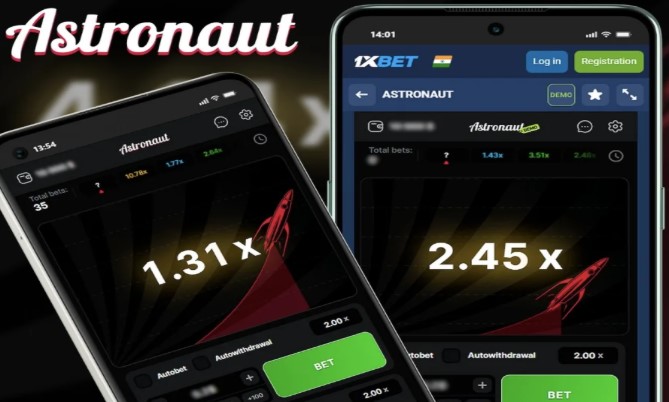
Documented versions of Astronaut include two betting panels. This allows players to place two separate bets during the same round. Each panel has its own stake and may support independent automatic withdrawal settings. The availability and layout of these controls should be checked in the current game client.
How Two Bet Panels Work
Suppose a player selects a 10-point stake in the first panel and another 10-point stake in the second. Both bets follow the same astronaut flight. However, the first bet might have an automatic withdrawal target of 1.50x, while the second uses 3.00x. If the multiplier reaches 1.50x, the first bet can be settled. The second remains active until its target is reached or the round crashes. Placing two bets does not create two independent crash events. Both are affected by the same round outcome.
Example of Two Bets in One Round
Consider these settings:
Bet A: 10 points, target 1.50x.
Bet B: 10 points, target 3.00x.
The astronaut launches, and the multiplier rises to 2.10x before crashing. Bet A reaches its target and returns 15 points. Bet B never reaches 3.00x, so its 10-point stake is lost. The total amount staked was 20 points. The total payout was 15 points.
Combined net result: -5 points.
This example shows why a successful withdrawal on one bet does not necessarily make the entire round profitable. If the crash had occurred at 1.30x, both bets would have lost.
How Does the Astronaut Crash Point Work?

The crash point determines when the multiplier stops increasing. Players can observe the multiplier during the round, but they cannot know the final crash point in advance.
Is the Crash Point Random?
Astronaut uses a system designed to produce unpredictable crash outcomes. The result of one round does not provide a reliable basis for predicting the next. For example, five consecutive rounds might end below 2.00x. This does not mean the next round must reach a higher multiplier. Each new outcome should be evaluated independently rather than treated as part of a predictable sequence.
Can You Predict the Next Astronaut Multiplier?
There is no reliable method for predicting the next crash point from previous results. A round history may show values such as:
1.25x, 3.40x, 1.10x, 8.75x, 2.20x
These numbers describe completed rounds. They do not reveal what will happen next. A long sequence of low values does not guarantee that a high multiplier is approaching. Software claiming to predict exact future crash points should be treated skeptically, especially when it does not provide verifiable technical evidence.
What Do RTP and Provably Fair Mean?
Return to Player (RTP) describes the theoretical proportion of stakes a game returns over a very large number of rounds. For example, a theoretical RTP of 98% would mean an expected return of 98 points for every 100 points staked across a sufficiently large sample. It does not mean a player receives 98 points after every 100-point session. Astronaut RTP figures vary between published listings. The value shown in the current game’s rules should be used rather than assuming that every operator offers the same configuration. Provably Fair refers to systems that allow players to verify outcomes using published cryptographic information. Some Astronaut versions are described as supporting this feature. However, a claim of provable fairness should be checked against the actual verification tools and instructions available in the game. Neither RTP nor provable fairness makes the next crash point predictable.
Astronaut Game Example: Three Different Outcomes
The following examples show how cash-out timing affects the result of a round. Each uses a 10-point stake and a different crash multiplier.
Example 1: Cash Out Before the Crash
A player starts with 10 virtual points and selects an automatic withdrawal target of 1.80x. The multiplier rises and reaches 1.80x. The automatic withdrawal succeeds. The astronaut continues until the round crashes at 2.40x. The player’s payout is 18 points, giving a net gain of 8 points. The later crash does not affect the completed withdrawal.
Example 2: Crash Before Cash Out
Another player selects a 10-point stake and an automatic withdrawal target of 2.00x. The multiplier rises to 1.35x and crashes. Because the target was not reached, the player receives no payout and loses the 10-point stake. The game does not return part of the stake based on the highest multiplier displayed.
Example 3: A Higher Multiplier Does Not Guarantee a Payout
A third player stakes 10 virtual points and sets an automatic withdrawal target of 5.00x. The multiplier continues rising through 2.00x, 3.00x, and 4.00x. It eventually reaches 4.95x before crashing. Although the multiplier came close to the target, the player receives nothing because the withdrawal condition was never met.
| Example | Cash-out Target | Crash Point | Total Payout | Net Result |
| 1 | 1.80x | 2.40x | 18 points | 8 |
| 2 | 2.00x | 1.35x | 0 | -10 |
| 3 | 5.00x | 4.95x | 0 | -10 |
These examples demonstrate the main rule: only a successfully completed withdrawal produces a payout.
Common Mistakes When Playing Astronaut
Most beginner mistakes involve the cash-out controls, payout calculations, or incorrect assumptions about previous rounds.
Misunderstanding the Cash Out Button
The Bet button places a stake before the round begins. The Withdraw button requests a payout during an active round. Pressing Withdraw after the crash cannot recover the stake. A withdrawal request must be accepted before the round ends.
Confusing Payout With Profit
A 2.00x payout does not mean a net gain equal to twice the original stake. With a stake of 10 points, a successful withdrawal at 2.00x returns 20 points. Only 10 points represent the net gain.
Assuming Auto Cash Out Guarantees a Win
Automatic withdrawal is a convenience feature, not a guarantee. If the selected target is 1.50x and the round crashes at 1.20x, the stake is lost. The system cannot process a withdrawal at a multiplier the round never reaches.
Trying to Predict Results From Previous Rounds
Players sometimes assume that a high multiplier must follow several low ones. This is known as the gambler’s fallacy. Previous crash values do not establish a reliable pattern for future rounds.
Using Two Bets Without Understanding the Combined Risk
Two betting panels create two separate stakes exposed to the same crash. If both bets are worth 10 points, the total amount at risk is 20 points. An early crash can cause both bets to lose.
| Common Mistake | Correct Explanation |
| Waiting until after the crash to withdraw | Withdrawals must succeed before the crash |
| Treating 2.00x as pure profit | The multiplier includes the original stake |
| Assuming Auto Cash Out always works | The round must reach the selected target |
| Predicting a high multiplier from previous rounds | Previous outcomes do not reliably predict the next |
| Thinking two bets reduce the overall risk | Both stakes can lose in the same round |
How to Learn Astronaut in Demo Mode
A demo version allows beginners to learn the interface using virtual points rather than real money. Demo availability may depend on the operator or region.
What to Practise in the Demo
Start by identifying the stake field, Bet button, countdown timer, and Withdraw button. Observe several rounds to understand when bets are accepted and when the multiplier begins rising. Next, practise manual withdrawal. Pay attention to the multiplier displayed when the request is completed. If automatic withdrawal is available, enter a target such as 2.00x and observe what happens when the round reaches or fails to reach it. You can also examine the two betting panels and compare total payouts with net results.
What Demo Results Cannot Tell You
A demo session helps explain the controls, but it cannot reveal future crash points. Winning several practice rounds does not demonstrate that the same results will occur again. Demo outcomes should be used to understand the rules rather than to develop expectations of consistent profits.
Frequently Asked Questions About the Astronaut Game
How Do You Play Astronaut Game for Beginners?
Select a stake before the round begins. When the astronaut launches, watch the multiplier increase and request a withdrawal before the crash. If the withdrawal succeeds, the payout equals the stake multiplied by the accepted cash-out value.
Is Astronaut a Crash Game or a Slot?
Astronaut by 100HP Gaming is a crash game. It uses a rising multiplier instead of spinning reels and symbol combinations. Some casino websites place it in their Slots category, but its mechanics are different.
How Does Cash Out Work in Astronaut?
Cash Out, often labelled Withdraw, allows players to collect a payout during an active round. The amount depends on the multiplier when the withdrawal is accepted. If the game crashes first, the active stake is lost.
Can You Play Astronaut Game for Free?
Demo versions of Astronaut are available through some game catalogues and operators. They use virtual points to demonstrate the gameplay. Availability may vary between websites and countries.
What Happens if Astronaut Crashes Before You Cash Out?
The round ends, and any unsettled stake is lost. A player does not receive a partial payout simply because the multiplier increased before the crash.
Can You Predict the Astronaut Crash Point?
No reliable prediction method is available. Previous results, displayed statistics, and multiplier histories do not reveal the outcome of the next round.
Does Auto Cash Out Improve Your Chances?
Auto Cash Out does not change the underlying crash probabilities. It simply requests a withdrawal when the multiplier reaches a value selected before the round.
Is Astronaut Similar to Aviator?
Yes. Both use crash-game mechanics involving an increasing multiplier and a withdrawal decision. However, their developers, interfaces, available features, and game configurations may differ. Rules from one game should not automatically be applied to the other.
Conclusion
Astronaut is a crash game where the main objective is to withdraw before the multiplier stops. Players select a stake, follow the rising multiplier, and use manual or automatic withdrawal controls. Understanding the difference between total payouts and net gains is essential. Beginners should also learn how dual bets work and why previous crash values cannot predict future results. A demo version provides a practical way to explore the controls without financial risk.
3 thoughts on “How to Play Astronaut Game: Rules, Multipliers, and Cash Out Guide”